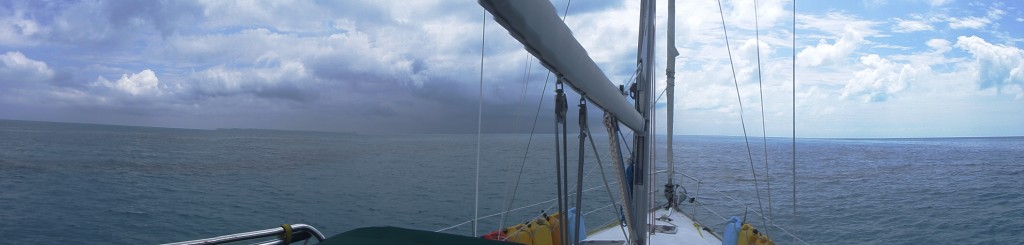
''Twenty years from now you will be more disappointed by the things you didn't do than by the ones you did. So throw off the bowlines, sail away from the safe harbor, catch the trade winds in your sails. Explore. Dream. Discover.'' – Mark Twain
I’ve put off writing anything about Hopetown on Elbow Cay in the Abacos. We ended up using it as a base (mostly for the internet connectivity) and spent the most time here of any place in the Abacos. Lisa and I loved being there. The question was “what to write about?!?”
Entrance to Hopetown Harbor and the water front.
The Hopetown Harbor is cute. That’s the only way to describe it. It’s dominated by the Elbow Cay Light House — a candy striped building from the 1800s that still uses 19th Century technology in the form of a Kerosene powered light that’s driven by counter weights (think grand father clock).
Elbow Cay Lighthouse at Sunset with Pearl on the far left.
The entrance is a bit intimidating. On our first approach, we weren’t sure that we were headed to the correct place. Our only clue were the channel markers — in what was very shallow water. Pearl had to go in on a high tide.
The Harbor itself is relatively small (and so crowded) so one’s obliged to pick up a mooring ball. The balls are about $20/day, but get significantly less expensive if you stay a week or longer. The land to which the balls are attached is know as “The Queen’s Bottom,” and are tended by locals who pay a fee for them and rent them out. Yup. The harbor is not a place to swim since there are no convenient pump-out facilities.
“Downtown” Hopetown is small. It has two streets, Front Street and Back Street, and a bunch of lanes that hang off of them. The houses are clap board cottages in much the same style as Old Town Key West.
There are nice Atlantic-side beaches here that are only a hundred yard or so walk from the dinghy dock. The beaches are not crowded and have conveniently accessible reefs to snorkel if you’re so inclined.
There are a couple of bars and restaurants that are fun. The most convenient of these is Captain Jack’s which has the best potato chips I have had, as well as a pretty darn good blackened fish reuben. There’s also Sip-Sip, a wine bar that’s a lot lower Key, as well as the Edge that competes with Capt. Jacks on alternate nights as the local disco.
Hopetown also is a good opportunity to provision. Stuff here is more expensive than in Marsh Harbor, however, a scant five miles away. After a while we got in the habit of heading over to March Harbor to provision. Initially, we stayed so long in Hopetown that some birds decided to build a nest in the radar reflector.
Lisa checking out an empty nest.
The people in Hopetown are relaxed, charming, and helpful. We had a great time. We made several friends, participated in wonderful dinners, and had fun learning how and where to fish in the area. Hopetown, however, has sharks. We didn’t fish for them as we did in the Keys.
Here are some pictures from Hopetown and northern Elbow Cay where it’s located.
The “Government Building” (Police Station, Post office, and Jail)
I think most people have heard of Portuguese Man ‘o War jellyfish — and are terrified of the stings they can deliver. I believe very few people, on the other hand, have encountered one.
Portuguese Man o’ War Jelly Fish are pretty common in the Florida Keys during certain times of the year. Lisa and I spotted one while we were sitting on in Pearl’s cockpit while parked in the Boca Chica channel off Key West one day. Lisa is an avid critter catcher, so we decided to take a closer look from the safety of the dinghy.
Initially, the Portuguese Man o’ War looks like a partially inflated plastic bag , container of some sort, or possibly garbage. On closer inspection, it looks like bluish sausage with an inflatable sail and a bunch of black strings attached to the bottom. It’s the black stings that are the stinging bits.
What we found really interesting was that the Man o’ War we followed sensed us and changed it’s behavior. Initially it seemed to want to get closer. After we had looked at for a bit, it seemed to want to get away. Besides being “sentient” the Man O’ War also seemed to have several little black fish living among it’s tentacles. Curious. Check out the pictures and video below.
All in all, this is a fascinating creature. According to Wikipedia it’s not just a single multi-celled organism, but a symbiotic colony of Zooids. You can read the entire wikipedia article for more details.
Getting from Little Harbor to Hopetown makes one feel like one is in a children’s story.
The route from Little Harbor to Hopetown. Note that the lighter the color of the water the shallower (around 2 ft) it is.
First you leave the Bight of Old Robinson (or Spencer’s Bight, as the case may be). Skirt around the top of Sandy Key navigate the shifting sands at the south end of the Tilloo bank. From there, it’s due north through Buckaroon Bay, keeping west of the Tilloo Bank, towards Witch Point.
It’s important to stay close to Witch Point, but not too close as there are shoals off it. Then, keep heading north staying close the west side, to avoid Lubbers Bank. Turn east around the north side of Lubbers Bank and head north, towards the Nothern most of the parrot keys. From there you spot the entrance to Hopetown Harbor…. Eh?
The preceding sounds a lot like directions that Johnny Depp would get in “Pirates of the Caribbean.” We love it here.
Having parked in Bimini for a couple of days, we took the next weather window to head for the the north eastern Abacos. This area’s reputed to be a cruising heaven, so guess what, we had to check it out. The area has great services, it’s easy to get boat parts, and maintenance work done, so it seemed like a great venue to do a shakedown (read breakdown) cruise to figure out what would work.
Our route from Bimini to the Abacos
There are a couple of ways of getting to the Abacos from Bimini. One involves going north from Bimini to Freeport and then around the top to West End. Otherwise, getting pretty much anywhere from Bimini involves spending a night out on the Bahama bank and heading through the Berry Islands. Since we hadn’t heard anything good about Freeport and in order to keep our travels to day light hours, we opted to spend a night out on the bank and go through Bullocks Harbor in the Berrys.
I was a bit paranoid about spending a night out on the banks. You’re anchoring tens of miles from the closest land in any direction. It isn’t that I have a problem with being out of sight of land, it’s a question of anchoring and encountering weather.
Driving Pearl into a storm on the Bahama Bank. Sails furled, hatches battened.
Crazy blue water. Things on the bottom 50 ft below were clearly visible.
North Rock light at the top of Bimini
I am soooo bored. My parent’s are no fun.
What do you mean I have to wear pants?
Yipee! I am toasty warm!!!
Storm done. Sun back out.
We picked what I thought was a great weather window. The predicted winds and swells were negligible. About a third of our way to our stop for the night at Mackey Shoals, we ran into a storm cell. We figured it would blow over, but instead it stayed with us until we got to Mackey Shoals. It quit just before we anchored for the night and gave us a spectacular sunset.
There are is a bunch of lead-up to this post that I haven’t got out yet. The bottom line is that Lisa and I have broken out of Key West, and are now in Bimini.
We made our crossing on the 20th. The weather couldn’t have been better. We left our anchorage at Rodriguez Key off Key Largo at 7:00am and were in Bimini and cleared though customs and immigration by 6:15pm.
I’d done a bunch of reading, blah, blah, but when it came down to it, we took slightly higher predicted winds out of the SE and did well for it. I had completely psyched my self out for this crossing and was on edge. Lisa was totally excited that we were finally doing something we’d talked about for a long time. What was nice was once we got in the stream, it wasn’t a big deal — it added between two to three knots to our boat speed. The increase is more significant if you look at it as a percentage: about 30% – 50%. I calmed down and had a nap while Lisa kept watch.
When we left Rodriguez key, we headed pretty much due south to the Molasses Reef Light. We kept it to the East of us to stay in clear water — per our friend Bill’s recommendation. About 0.5 mi out from the reef, we raised the sails in 13 – 16 kts of wind, set a heading of 80 magnetic (71 True) trimmed the sails for a close reach (60 deg. off the wind) and kicked back. We decided to motor sail as I wanted to get to Bimini as soon as possible. With the engines turning 1200 rpm and the sails up, we averaged 7.5 kts for the first quarter of the crossing. The wind picked up to 20-25 during the middle of the crossing and we averaged 9 kts. The wind stayed with us until we were about 15 mi off Bimini, when it dropped to 10 -12 kts. The swells we pretty consistantly out of the south at about 1 – 2 feet almost all the way acrossg. They got up to around 3 ft beginning 7 mi off Bimini.
Seriously? You want me to drive?
Landfall on Bimini
Can you see the markers?
Blue water — and shoals!
In the Channel
A Little Cay in the Channel
The Marina
Checked into the Bahamas!
The entrance to Bimini was a bit challenging for me. The entry is marked by a couple of sets of buoys. That’s it. There are several people who’d told me that once you made the turn into the harbor, we’d be running about 100 ft off the beach. I thought that was probably an exaggeration, but it wasn’t. The channel is pretty narrow and very close to the beach. It’s also very shallow at the entrance. Pearl touched bottom once on the way in. We also ran aground en route to our slip at Bimini Blue Water but got off without a problem.
What we did well was cross the gulf stream comfortably and safely. When we do this again, i would, however, leave earlier — at about 4:00am rather than 7:00am. The reason we didn’t do this is because I wanted to see the stream in the light. Pulling off the crossing was a big deal for me. It validated that a lot of what I thought and had learned was correct — an exam, kind of. Behind our “pass,” however, there is a large group of people who have coached, cajoled, counseled, and conspired, with us to make the adventure we are on a reality. Most of them are breathing easier now that Lisa and I are no longer in Key West.
At present, Pearl is safely tied up to a dock at Bimini Blue Water. We had a great day touring Bimini. More on our impressions of Bimini soon.
Hi Denise! Remember the nightmare you had about getting up in the morning and finding an alligator in the cockpit? Well, Lisa almost had a similar experience on the bow. Say “Hello!” to our little friend.
As you see, this critter is contemplating moving into the anchor locker. Fortunately we caught it before it went in as I am not sure it would have been able to get out.
While it would have been HILARIOUS to see Lisa’s response to finding this critter while trying to anchor. There is a fairly good chance that I would have found it. You know how enthusiastic I am about wrangling squiggly things.
Fortunately, the patter of little feet we’d hear on deck periodically was not a giant rat (I refrained from investigating), but this guy or one of his cousins.
We hope you are being good, or least being good at it. With us, the adventure continues.
For a little over the past year, Pearl was tethered to the dock at the Key West Yacht Harbour. As marina’s go, this place is nice. It has a resort-like feel to it. On the one hand you are at a marina with a bunch of other boats. On the other, some of the slips were set up so that there’s vegetation behind you. It didn’t feel like an RV park with no elbow room between you and your neighbors.
The facilities here are great. There’s a pool, a restaurant, gym, and a Tiki hut where people gather to watch the sunset with a beverage of their choice. Also, there is a potluck on Sundays that got people meeting each other and socializing. Very civilized!
Neither Lisa nor I are pool people. There’s a nice sand bar nearby on which to hang out and allow Harley to swim pretty close by. Also there is great fishing right outside the Marina — where Lisa caught a decent sized Tarpon.
This place has worked out well for us! We’ve met a bunch of people and made several friends. We’ve had fun here, but it’s time to move on.
Yesterday, we spent our first night at anchor in a very long time. I can’t explain how happy that made me.
We are anchored off the Key West harbor Marina where we’d been tethered to a dock for over a year. It’s a place I wanted to try since we got there, it’s a place we’ve been through innumerable times fishing in the dinghy and on the little Key West. We are at anchor now. All the hatches and ports on Pearl are open. We have a nice jazzy radio station on the the background, and we are sorting through the accumulated junk from life at a dock. Shortly Pearl will be lighter, tidier, and ready to put out.
Right now, she sitting comfortably in the wind and current. Tarpon are rolling around us. That’s what she was meant for. Bliss.
Having installed an air conditioner, we then faced the questions of powering it while at anchor. If you are wondering about our sudden fascination with air conditioning, while the ideal is a boat swinging quietly at anchor, loved one(s) ensconced comfortably in the cockpit sipping chilled “Dom Peringnon,” listening to the quite tropical music….The reality can be sweat soaked nights spent in a stifling boat with swarms of bugs from the apocalypse eating you alive. We said “NO!” to that. We added a generator.
As you know from the Air Conditioner story, space on Pearl is limited. Getting a generator was once again a challenging balance of power requirements vs. form factor. The ideal generator to get would have been a Yamaha 2500. The space we have, however, would not permit that. So back to the 2000 watt gennys.
While there are several generators in this class, we decided that we wanted either a Honda or a Yamaha. We considered the Hyundai which looks comparable, but decided against it because of the poor reviews on Amazon. Both Honda and Yamaha are reputedly super quiet and super reliable — and theoretically can support our AC, a 16000 BTU Dometic/Marine Air Envirocomfort.
The full load on the generator is 10.5A for the air conditioner and 2.35A for the March Sea Water Circulation pump. While this is 12.85A, close to the rated load the tricky bit seems to be handling the power surge that hits the generator on startup.
Comparison of Honda 2000i vs. Yamaha 2000i
Honda 2000 i
Yamaha 2000 i
Displacement
98.5cc
79cc
AC Output
120V 2000W max.
120 V2000 watts
Max
16.7A
16.7A
Rated
13.3A
13.3A
DC Outputs
8A @ 12V
8A @ 12V
Starting System
Recoil
Recoil
Fuel Tank Capacity
.95 gal
1.1 Gal
Runtime
3.4hr @ rated load 8.1 hrs @ 1/4 load
10.5 hrs @ 1/4 load
Dimensions (LxWxH)
20.2″ x 11.4″ x 16.7″
19.3 x 11.0 x 17.9 in
Noise Level
59 dB(A) @ rated load 53dB(A) @ 1/4 load
Weight
45.6 lb.
41.1 lb
Warranty
3 yrs
3yrs
The specs for both generators are essentially the same, except that the Honda has a 25% larger motor and the Yamaha has a larger fuel tank and run time. If you do a feature comparison, the Yamaha seems to be a bit better set up for regular use. For example, it has a fuel shut-off that lets you run the tank out of gas. This is important if you are using ethanol enriched fuel as the ethanol dries up in your fuel line causing all kinds of aggravation.
In all of the reviews we read online (mostly RV sites), there was some mention that the Yamaha would not support the power surge when an air conditioner started, but the Honda would. This seemed a bit sketchy given the identical specs, but we wanted to investigate the issue before committing. There is nothing like buying a bit of equipment that doesn’t work that you can’t return. So off we went to the Yamaha dealer.
Note: There is a soft starter that should theoretically reduce the power surge when the air conditioner starts up. That, however, adds an additional $500-ish to the project cost. When you look at the electrical components on the Dometic AC, there are a couple of large capacitors that made me wonder about the utility of a soft start. This discussion on Sailnet is worth reading if you are planning to install an AC and run it off a generator.
Vince, the sales manager at Garrison Bight Yamaha (local Key West Dealer who we know from other Yamha gear we have) listened to my tale of woe. He immediately offered to let us borrow and test one of the generators. In fact he brought one over to Pearl the next morning for us to try out. Our test were a bit disappointing. The Yamaha failed — unequivocally. Try as we might, we could not get it to power the air conditioner — even the power cord made a difference.
We also testes a Honda 2000i belonging to our friend James from Sail Florida Adventures. His Honda worked— no problem. Actually, James has a Beneteau with the same Air Conditioner so we were pretty sure it would work. We just wanted to verify it for ourselves. Caveat emptor.
While we would like some of the bells and whistles on the Yamaha, we are thrilled that we can now have air conditioning while at anchor with the Honda! Friends at the marina we are at have joked that we’ve now moved from being sailors to Yachtsmen. Perhaps. There is something to be said for creature comforts, particularly not being chewed up by bugs.
I’d love to hear about your experiences with generator and air conditioners if you have any — or about minimalist sailing which we seem to have eschewed.
There’s a Southern phrase, “I’m fixing’ to …” that usually means “I am preparing to ….” Since it’s Spring, Lisa and I have been thinking about cruising again. In other words, we are “fixing’ to go cruising.”
Unfortunately, that phase has take on a whole new meaning for us. We’ve literally been fixing Pearl for the six weeks. We installed an air conditioner, we’ve replaced the batteries and charger, changed Pearl’s registration, replaced the fluxgate compass and recalibrated the autopilot, and now we are messing with the refrigeration system. The refrigeration system failed before we tried to leave the last time. Guess what? It did it again.
Harley chilling out on deck. He couldn’t be more relaxed.
Having determined that there should be no magical boxes on Pearl, we’ve dug into the refrigeration system. It’s both simple and interesting. It is has an air cooled compressor/heat exchanger (unlike our air conditioner which has a water cooled heat exchanger) and two cold plates, one each in the fridge and the freezer. The way the system works is the compressor and heat exchanger cool the refrigerant, pass it through the first cold plate in the freezer, then through a constant pressure valve, into the second cold plate, and back. The system is controlled by a thermostat on the cold plate in the fridge — it really doesn’t matter how cold the freezer gets as long as the fridge stays at temperature (about 35F). There are no fancy electronics here, just tables mapping temperature (remember Boyle’s Law?) and pressure and a mechanical control in a closed system.
There are two pressure readings that apply, one is the “low side” pressure for the cooled refrigerant where it exists the compressor/heat exchanger, and the “high side” for where it returns to it. The magic here is balancing the high and low sides with a combination of adding refrigerant and twiddling the constant pressure valve until it equalizes out. It’s not quite rocket science, but the same principles that apply in the combustion chamber and nozzle of a rocket engine apply here. Hmmm. Maybe it IS rocket science.
The base line pressure for the refrigerant on the low side should be 2-3 psi. The high side pressure depends on the ambient temperature.
Where we’ve been running into a problem is getting the pressure balanced between the high and the low sides. So far, this has been the result of a faulty constant pressure valve, and or some debris in the low pressure line when the valve was last replaced. Also, there may be a very small leak in the system that causes refrigerant loss whenever the freezer is defrosted. To find that we need to pressurize the system with Nitrogen to about 500 psi. I hope we can skip that for the moment.
Lisa and I have had a couple of hard weeks. We’ve had a variety of projects to wrap up on Pearl. Things have broken. Components have died. We’re sore from assuming unnatural positions for other than “recreational” purposes. Our joints are bruised. We have burns. Pearl, our home, has experienced “uncontrolled water intrusions.” And one wonders, “Why not return to living in a nice little cottage instead of something the size of a large bathroom?!?”
The answer is because of evenings like this: a fantastic rising Blood Moon, with leaping sting rays. After that, pretty much everything seems trivial.
Lisa and I don’t do well together when it’s too hot to sleep. We bicker. Tempers fray. Harley the dog tries to find a place to hide. None of that works well on a small boat.
A couple of summers ago we solved this problem by jerry rigging a window-type AC on deck to keep us cool. While cost effective and functional, the jerry-rigged solution is (as a friend of mine put it) ghetto-fabulous. It also makes taking Pearl out sailing a major production causing us to stay in rather than go sailing.
Having turned 50, I relented. I decided that I should follow Lisa’s advice and we should bite the bullet and install an self contained reverse cycle air conditioning system. The upside is that we can have air conditioned (both heating and cooling) comfort wherever we go — particularly if we add a a generator. The downside is the expense, installation aggravation, and loss of storage space.
Having finally consumed most of the stuff we provisioned for going to the Bahamas last year we agreed we could use the lose the roughly 2 cubic feet of space the the air conditioner and 4 cubic feet the ducting would consume. Note to self: don’t over provision. Also, we’ve been freeing space by tossing out stuff we (mostly I) thought was essential.
One can spend truly egregious amounts of money on an ACs and installation. Yes. There are such things as “bespoke” air conditioners — custom made units to fit in specific places in a boat — and it’s really easy to get sucked into thinking you need one. Having looked at the options, however, and friends who’d done their own installs, Lisa and I decided that we would purchase a kit and do the installation ourselves. It’s not rocket surgery, after all.
What we learned from out experience:
Measure several times, cut once.
Lay out every component and ensure that you have the space to do what you need to — e.g. connect fittings, hoses, and hose clamps — and leave extra hose and wire so that you can do maintenance.
Ensure there is a constant upward. flow of water from the through-hull to the filter, then the pump, and air conditioner — if you do this, you don’t need to worry about priming the system.
You don’t need to install a sump and possibly separate thru hull for draining condensation. A couple of vendors (Marvair and Mermaid) offer venturi pumps that attach to the discharge hose.
Double the time you think it will take to get anything done.
Also, consider taking yoga classes to prepare yourself for the unique positions in which you will likely need to pose yourself to install some of the components.
Fortunately for us, Beneteau offers the 373 with a factory installed air conditioning as an option. Beneteau’s Customer Service very helpfully provided us with the schematics and a parts specifications for the ACs they install, as well as pictures of someone else’s installation. While we did purchase several parts from Beneteau for the installation, we didn’t get all of them — in some cases because they just weren’t available.
As it turns out, the Dometic Marine Air 16000 BTU Retrofit Kit fits perfectly in the space mapped out. We tried a Webasto 16k BTU but despite the specs indicating it would fit, we just couldn’t wrangle the unit into place. We bought our system from West Marine, and avoided getting the install kit in favor of buying individual components. This ended up being less expensive than buying the “kit” and had better components — e.g. brass rather than plastic fittings.
The AC in place under the Port side settee. The grubby bilge is from the condensate buildup — which should be addressed by the Marvair Condensator.
The most demanding part of the installation was running the plumbing. While we had a “spare” through-hull fitting that we were able to use, getting the water filter, pressure pump, and air conditioner on a consistently increasing gradient was a bit of a challenge. We still need to fiddle around with this whenever the filter gets clogged.
Fortunately, Lisa is both small and flexible. Running the pipes and attaching the necessary hose clamps and fittings in tight spaces required some impressive contortions on her part. Regrettably, there is no photographic evidence of her feats as my picking up a camera would have resulted in “bad things” happening. I am not sure what the bad things are, but i prefer not to find out.
The most traumatic part of the install was cutting into Pearl’s cabinetry and drilling a hole in her hull. With the right tool, anything is possible. We ended up getting a Rigid Multi-Tool from Home Depot for cutting the holes for the return air vent, ducting, and the thermostat/control head. The multi-tool was far easier and more precise and manageable in the confined spaces we were working in than either a rotozip or a jig saw — we tried to use both. The mutl-tool was well worth the $65 cost. Prior to this, I thought they were completely pointless. For the vent into the salon, we needed a Milwaukee 5″ hole for which we used a hole saw. These tools, along with a nut drive for tightening the hose clams made the install quite manageable.
The other part of the story was hooking up the power. This wasn’t too bad. Instead of trying to patch into the existing wiring and adding a circuit breaker, we opted to run a completely seperate dedicated 30 amp circuit for the AC — complete with a Beneteau standard Merlin Gerin Circuit Breaker. There is nothing else on the circuit. This way, if we choose to run the AC while at anchor all we theoretically need to do is plug in the generator.
There is one other component we need to install. It’s a Venturi pump made by Dometic/Marvair that evacuates the condensation pan that currently drains into the bilge. While, once again, you can jerry rig a much less expensive solution using fish tank supplies, we figured the potential downsides out weighed the higher cost. Hopefully, once this is complete, we’ll be back to having a clean, dry bilge!
We love having our AC so far. It works much better than the ghetto fabulous cabin-top jerry rigged unit we had. It dries out the inside of the boat — which is nice — and keep the outside of the boat cleaner and less cluttered. Good call Lisa. Stay tuned for more.


 There are a couple of bars and restaurants that are fun. The most convenient of these is Captain Jack’s which has the best potato chips I have had, as well as a pretty darn good blackened fish reuben. There’s also Sip-Sip, a wine bar that’s a lot lower Key, as well as the Edge that competes with Capt. Jacks on alternate nights as the local disco.